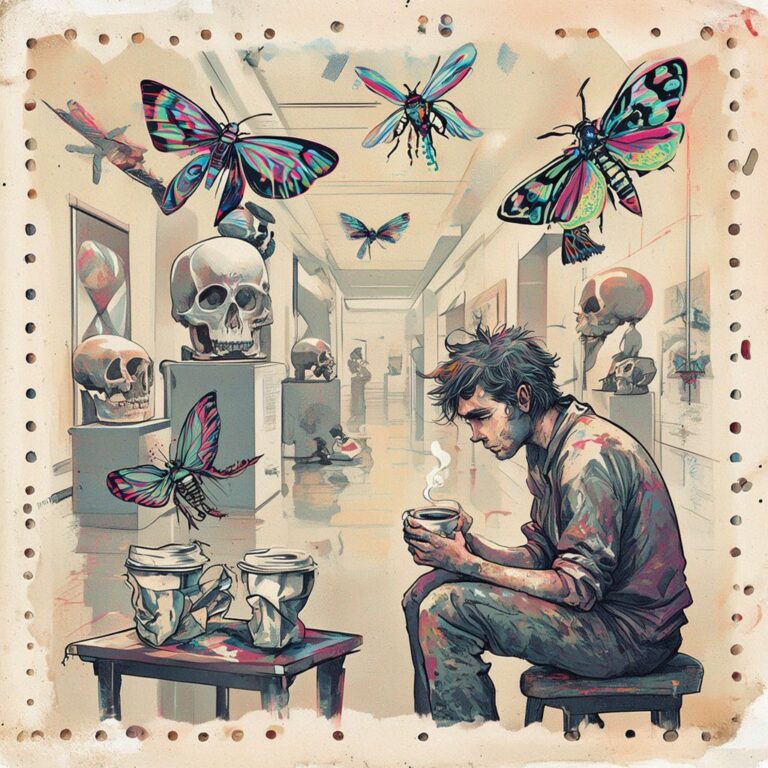
Once a month, someone in Indieweb hosts the "Indieweb carnival", a monthly theme which a bunch of bloggers all write about the same theme, and the links to posts are collected in a page together. This month's theme: Museum Memories (see the announcement post, and the roundup and recap of all submissions.)
Like many people, I have many fond memories of museums. Here are some recollections.
Sections:
- How I Learned Duane Hanson Isn't Alexander Calder, and Leonard Nimoy Really Is Not Spock (Whitney Museum, New York City, 1978?) • 700 words
- Forever In Their Heart (The Franklin Institute, Philadelphia, 1970s) • 350 words
- Her Luminous Eyes (The Mütter Museum, Philadelphia, 2012 • 2150 words)
- Panic At The Explo (The Exploratorium, San Francisco, 1996) • 1200 words
- How A Chance Scientific Injustice Launched My Career As An Author Of Doggerel (The Boston Science Museum, Boston, 1993) • 250 words
- Honorable mention: Long Wires in Dark Museums by Alastair Galbraith and Matt De Gennaro (Table of Elements records, 2002) • 75 words
Plus a bonus gallery of work-in-progress featured images for this article.

1. How I Learned Duane Hanson Isn't Alexander Calder, and Leonard Nimoy Really Is Not Spock (Whitney Museum, NYC, 1970s)
When I was in about fourth grade, my school's front hall was decorated with a little exhibition photos of various working people posing for portraits: cleaners, carpenters, etc. Mrs. Himmelstein, my art teacher, who let us play records in art class, told us they weren't photos of people... they were ultra-realistic sculptures, and if we liked them, there was a whole exhibit at the Whitney Museum. I guess my folks looked into it, and it turned out there was an Alexander Calder exhibit at the Whitney too... it was pretty much a perfect museum double-bill for an 8-year-old.
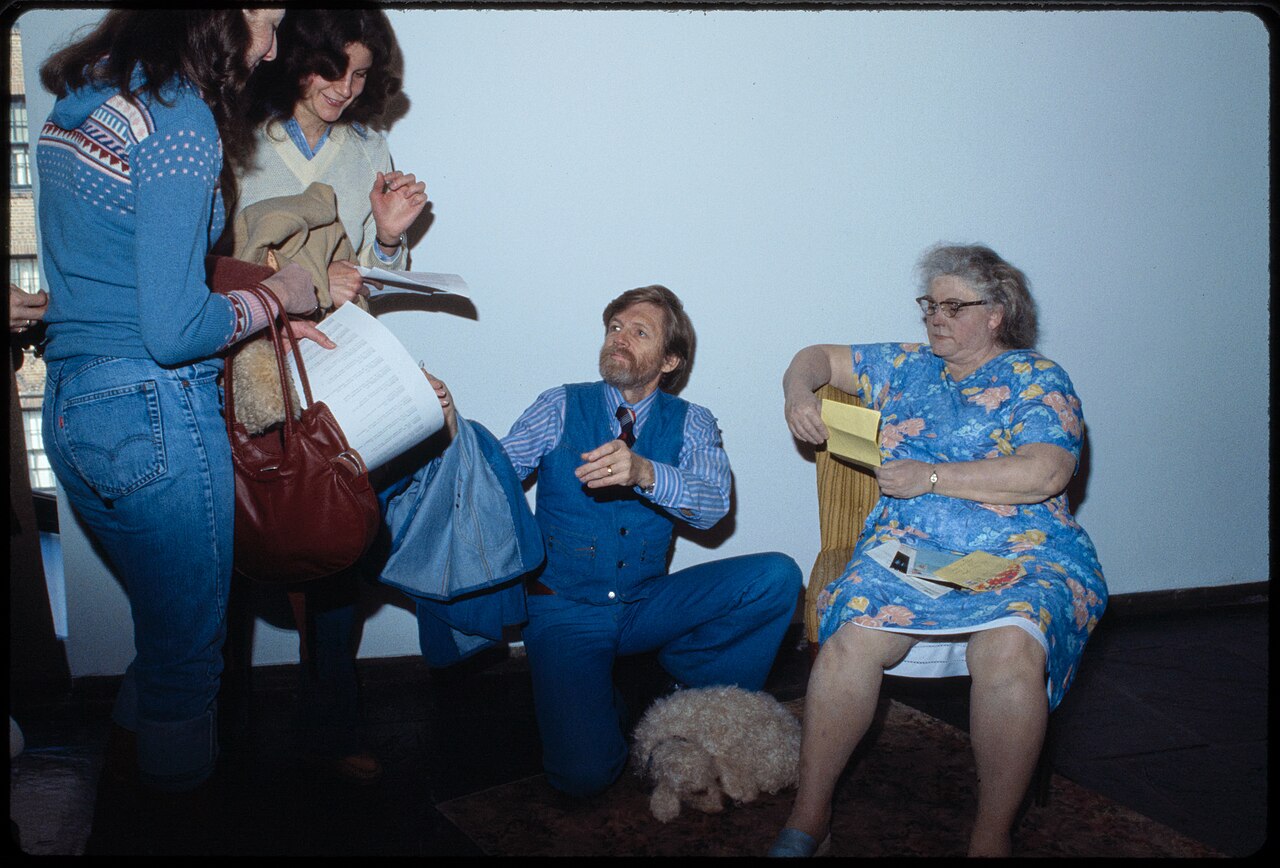
The sculptor, I now know, was Duane Hanson. Hanson's hyper-realistic sculptures were uncanny. The museum had sprinkled them throughout the building: a tired-looking waitress leaning against a pole in the cafe, a security guard standing by the payphones. More than once my dad got me to go talk to one, thinking it was a person. ("Go ask that waitress where the bathrooms are.") At one point, we looked at one that had a crowd of people gathering around it, an old woman sitting crosslegged on the floor, reading a folded up newspaper. Suddenly, she exhaled, and laughed. She admitted she'd been waiting for somebody, and sat down to read the paper, and a crowd had started to gather around her, so she held her breath as long as she could, and fooled everybody! Anyway, that's how realistic Hanson's sculptures were... a person sitting still long enough looked like just another sculpture.
And then, of course, there was the Alexander Calder exhibit. If you're familiar with Calder, not much needs be said, and that day was my first exposure to perhaps the most playful sculptor in modern art history, and a perfect museum exhibit to bring a creative and fun-loving 9-year-old to. I've loved his kinetic mobiles and circus sculptures from then to now.
Anyway, after a day of checking out very cool and unusual art, my folks pointed excitedly across the room in the gallery at a man I didn't recognize at all. "Look, Mike!", they said. "It's Mr. Spock!" Now, I was a huge Star Trek fan, and had probably already seen the entire series (you do know there was only one Star Trek series, right?) several times over even by that age, as it ran every night at 6PM, 5 days a week. I said, "That's not Mr. Spock." And then I saw somebody go up and ask for his autograph, and realized, yes, it was him!
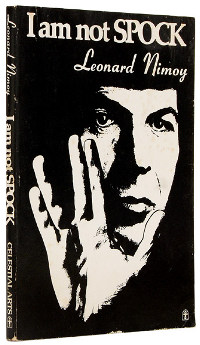
By here., Fair use, Link
I went up and asked for his autograph. I said, "I see you on Star Trek every night". I don't recall him saying a word, but he signed the margin of my museum program or some other piece of paper I had convenient. He seemed a little dour in retrospect, truth be told. My dad told me, "You know, Star Trek was a long time ago." And I know now, as an adult, he was only 2 or 3 years past publishing "I Am Not Spock", perhaps still kind of in that phase. But I don't recall it even registering with me, at the time, that he'd been perhaps a little grumpy.
And, I don't care.
Leonard Nimoy gave me an autograph. At an Alexander Calder exhibit. It's a prized childhood memory.
Funny thing, Hanson and Calder and the Whitney all have comprehensive exhibition histories online now. I can't find a single date when both Hanson and Calder were on display at the Whitney. But it happened. For a very long time I thought the whole thing had been a Calder exhibit, and that Calder made both his fanciful mobiles and sculptures and ultra-realistic human sculptures. It wasn't until I was an adult that I learned the real reason I'd gone to the Whitney at all was Hanson.
2. Forever In Their Heart (The Franklin Institute, Philadelphia, 1970s)
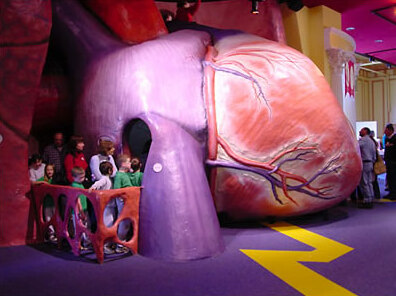
I grew up on Long Island, but being right outside of New York City, it was only about a two-hour drive to Philadelphia. One thing we did many times when I was a kid was visit a place that I consider sacred ground: The Franklin Institute. This was a participatory kid's science museum that felt more like an amusement park to me.
The thing I remember most clearly is the giant walk-through model of the human heart.
Another thing it had was a real, working Foucault Pendulum... a huge spherical pendulum, down the center of an immense stairwell, weighted to keep perfect pace with the rotation of the earth. A pin extended from the bottom of the pendulum, and a circle of chess-piece-like pins ringed the perimeter of an illustration of the earth beneath it. It would knock over a pin approximately every 25 minutes, so that every 24 hours, the pendulum would knock over all the pins. I always wished I could be there at midnight, when I imagined a scene of workmen dodging the moving pendulum, trying to re-set all 24 hours' worth of pins back up again while not getting clocked by it. (As it turns out, the pendulum doesn't swing forever, the museum starts it each morning, as explained in the description of this time-lapse video from the Institute. I am disappointed.)
I don't really have more of a story than that to tell about the Franklin Institute. It was just a fun place to visit, a big part of my childhood and always a special treat to go to when I was growing up. I didn't even realize it was educational.
Afterword, April 2, 2026: I'm pleased to note that, while I gave the Franklin Institute pretty short thrift here, Jesse Miksic of Philadelphia, in his "Museum Memories" submission, gave it the fuller writeup it deserves. Thanks to Jesse for reminding me of the Institute's Foucault pendulum, which I hadn't included in this when I first posted it, and only just added now.
Speaking of Philadelphia... what I really wanted to talk most about was the Soap Lady and the Mütter Museum.
3. Her Luminous Eyes (The Mütter Museum, Philadelphia, 2012)
As a young man, I learned of Philadelphia's Mütter Museum from a beautiful essay by Raymond Teller, of Penn & Teller, in their book "How To Play In Traffic".
The Mütter, owned by the Philadelphia College of Physicians, preserves the 19th century medical specimen collection of Thomas Dent Mütter, who collected examples of "extremes in human morphology". For a 150-year-old medical exhibit, described as being in a Georgian building behind wrought iron gates at something called the "Philadelphia College of Physicians", I imagined something sort of dry, dignified, and academic, about like I always envisioned an Oxford University library, but with human remains in cases.
In "How To Play In Traffic", Teller has a beautiful essay on the Mütter and what he appreciates about it, and I encourage anyone interested to find the book and read the essay. One particular passage always stayed with me, which I hope, as Libertarians, Penn & Teller will forgive me for quoting in full:
"In fact, as I look around, the entire museum is reticent, waiting to be looked at, but unwilling to explain away its mystery. There are no babbling pushbutton recorded explanations; even the labels are terse and sometimes cryptic. And this is as it should be. For these things around me are not textbook illustrations, but actual pieces of life suspended in a world beyond time, pain, and passion. Like life, they are not inclined to explain themselves. So we look, think, study, wonder. When school children enter the Mütter, they instinctively start talking in whispers and chewing their gum thoughtfully. Tattooed teenagers with nose rings, who come to show how cool they can be in the face of freaks and death, grow introspective when they realize that what they are looking at is real, important, and very beautiful.
"No one is quieter than the Soap Lady. She is a short, stout, nude woman the color and texture of fallen leaves in November. She has slept in a glass case at the Mütter since 1874. She was fat, and when she was buried the temperature and moisture of the grave were just right for causing her plump flesh to transmute into adipocere, a soaplike substance. She led an undistinguished life, but now she is a star, having made her mark on the world at the last possible moment—as she was decomposing."
The essay doesn't have many illustrations, so for many years that passage was all I had to inform me about what the Soap Lady looked like.
Morbid child that I am, I always wondered.
I've always had something of a deep and troubled relationship with the sense of impermanence or loss. (Avid readers may notice that loss is a recurring and deeply moving theme for me.) As a child, my mother was mystified when I broke down in tears because stepped on a waterbug. Slightly older, traveling the Catskills as a family, they were again mystified when we walked through the remains of an old resort town, now mostly reclaimed by the forest, and I once again broke down sobbing when my dad stopped in front of a untamed-looking patch of woods and said, "There used to be a three story hotel here." My mom asked, "Why are you more upset than he is?" I didn't know. 50 years later I still don't.
Later on in life, I developed a passing fascination with the art aesthetic known as the Decadent movement and poets like Charles Baudelaire, who saw transcendent beauty in loss and impermanence, and became a fan of songwriter Robyn Hitchcock, whose best songs are full of memories, bones, half-light and mouldering specters of the past.
Later still, my memory was indelibly impressed with the incredible capital-'D'-Decadent beauty of the photography book "Evidence" by critic and photo historian Luc Sante—a collection of mostly anonymous, unsorted 1910s crime scene photographs discovered by Sante, haphazardly stored in the basement of a New York City police precinct, while researching another book. Sante presents the photos initially with no commentary, later in the book providing an appendix with what very little background is known about individual photos, plus penning a beautiful essay on the relationship between photography and mortality.
Sante has a lot of to say on that idea, but one point that stayed with me is that, in most of the photographs printed in "Evidence", we know literally nothing about the victims pictured except what we see within the boundaries of the photographs—in most cases not even names.
We might guess, but nothing can really by surmised save what we see: these two-dimensional images are all that remains of an entire human life... and, Sante points out: these people are the lucky ones.
We still see their faces. They were not lost entirely to time, completely forgotten—as the vast majority of people eventually are. That thought has stuck with me for the at least 30 years since I first saw "Evidence".
And so, being predisposed to a fascination with such things, the Soap Lady, and Teller's thoughts on her, captured my imagination. Even more so because Teller, despite seeming especially moved by her, and having painted such a moving picture with his words, tantalizingly didn't include a photograph of her.
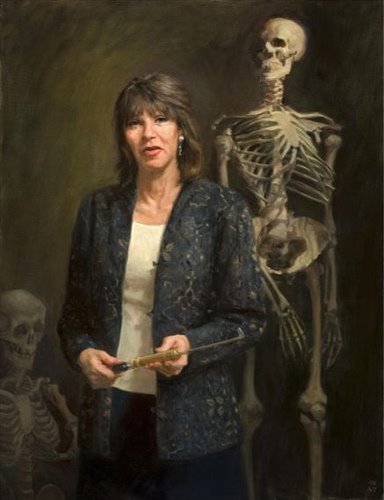
In 2002, the late Gretchen Worden, director of the Mütter for nearly 30 years, published a book about the museum, and as part of her publicity tour came to City Lights Books in San Francisco and gave a talk and slideshow about the place.
I attended with rapt attention. She showed photos of many of the things Teller had described in his essay, but I was waiting for the thing I was most curious to see—and she didn't show it. So when she opened the talk up for Q&A at the end, my hand shot up, and I asked her:
"Why didn't you bring a picture of the Soap Lady?"
I'm sorry to say I don't remember the specifics of her response. I recall that she seemed charmed that someone had asked that particular question. But I don't remember the reason the Soap Lady hadn't made it into her presentation. The fact that I don't recall it means it was probably fairly pedestrian, probably blamed on time constraints or something of that nature.
Fast forward a decade, to 2012.
I was hired to do some IT work at a trade show in the Philadelphia Convention Center. So, once I could grab a few hours off, first thing I did was finally fulfill a dream of decades, and make my way over to the Mütter Museum, happily within easy walking distance of the convention center (along with a lot of good places to get a cheesesteak.)
I have to be honest: in some ways, I was a little disappointed.
As I said above, I'd expected something very grand, imposing and academic. In reality it is a fairly small building, and just a touch more sensationalistic than the staid and academic hall I expected, like a tourist destination or a "Ripley's Believe It Or Not"... glass cases crammed with too-small and too-large skeletons, wax casts of unfortunate people with odd bodily protrusions.
It was still fantastically interesting, and I got to see many of the things I'd read Teller's descriptions of, mostly presented basically respectfully—but somehow, it seemed to me, still slightly more as lurid curiosities than the with deep and beautiful appreciation Teller's description had imbued them with. It felt like a display, not a study.
The upper floor of the museum is less dense with displays, and walking around a divider in a quiet gallery there, I came upon her glass case, and finally got to see the Soap Lady.
She is, as Teller described her, "a short, stout, nude woman the color and texture of fallen leaves", and so quiet and still that it seemed to emanate from her and envelop the surrounding space. The museum is primarily designed to be walked through, but whether by accident or thoughtful design, somebody had left a chair right where a visitor, so inclined, could sit alone with the Soap Lady in her corner of the gallery, and see if they could catch a glimpse of eternity.
There've been a few times in my life I was moved to unusually long spells of silent appreciation: hours spent just looking at a view, a piece of art, or the like—just being with it. I've become absorbed in unusually long contemplative silence in front of Monet's Water Lillies; lost in my room listening to an all-enveloping piece of music; on a memorable early morning alone on top of El Capitan in Yosemite, watching the sun rise over the Sierra Nevada; and on occasion for hours, long after dark, on those chilly nights when you can find that rare Manhattan solitude on the water's edge at the Hudson or East River. This was another one of those times.
I sat and looked at the Soap Lady for about a half hour, not thinking much, just me being me and her being... nothing. A famous remnant of an anonymous life long gone, a modern bog lady. A absence given physical form, eternity in the roughshod image of a woman. A soft fossil in tallow. Soap.
Nobody wandered through that little nook of the museum in that entire time, and I spent maybe 30 minutes in perfect contemplative stillness with the Soap Lady, before my decades-long curiosity about her was fully satisfied, and I got up and left her to silently receive her next 150 years of visitors.
I understand, now, having seen the Soap Lady in person and also since then in photographs online, why Gretchen Worden did not include her in her traveling slide show of the Mütter's exhibits, nor does the Mütter Museum's own website include a photo in their article on her.
The Soap Lady, you may be surprised to be told after all I've said about her, is extremely unpleasant to look at up close.
She is still, but her appearance is not peaceful. Suffice to say, natural forces have no respect for human comfort and decency, and are indifferent to our squeamishness or revulsion, and the Mütter Museum is unflinching in what it displays. I would prefer not to describe her appearance in more specific detail than that.
But with a photograph, the appearance is all you can get.
Anyone who's ever been alone in a room with the mortal remains of a deceased person knows that the appearance alone, what the camera can capture, does not convey the experience—it only conveys visible externalities, which seem in a real-life moment of such gravity to be an especially trivial attribute. And with the Soap Lady, given her physical condition, the difference between the mere visual appearance you would get from a photo and the actual presence is even more stark.
Seeing just the state of her remains, even having her appearance described, would not just fail to do the Soap Lady justice—it would give precisely the wrong impression. Visually, her appearance is a visceral horror, the residual effect of putrescent processes that evolution has bred us to find repellent. But within that room, in person, there is no question why she rests in perpetuity on public display. There's a reason somebody, some kind soul, put that chair there.
In my favorite translation of the poem "Beauty", in my 1919 edition of "The Poems And Prose Poems of Charles Baudelaire", the decadent poet's lines are rendered as:
BEAUTY
"I am as lovely as a dream in stone,
And this my heart where each finds death in turn,
Inspires the poet with a love as lone
As clay eternal and as taciturn.Swan-white of heart, a sphinx no mortal knows,
My throne is in the heaven’s azure deep;
I hate all movements that disturb my pose,
I smile not ever, neither do I weep.Before my monumental attitudes,
That breathe a soul into the plastic arts,
My poets pray in austere studious moods,For I, to fold enchantment round their hearts,
Have pools of light where beauty flames and dies,
The placid mirrors of my luminous eyes."
Those lines were composed while the Soap Lady temporarily suffered the fate that awaits most of us permanently, laying forgotten and anonymous, long decades after her death and prior to her later discovery by exhumation and rise to a unique post-mortem fame. Yet, they could have been written about her. I know from later reading that that's not the best or most literal translation of "Beauty". But Baudelaire, told through the voice of that later unknown translator, got it right.
There's a certain poetry in stillness, and the Soap Lady is the poet laureate of that austere, breathtaking Baudelairian chill.
4. Panic! At The Explo (The Exploratorium, San Francisco, 1996)
San Francisco's Exploratorium is not quite the opposite of the Mütter Museum—more like its inverse: teeming with life and activity, as amazing for being bustling and interactive as the Mütter is for being quiet and contemplative.
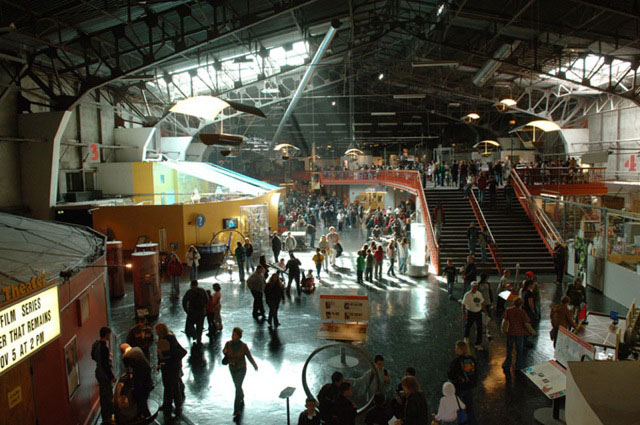
The Science Digest article is lost to time but I still clearly remember saying to my mom, at that age, "Hey Mom, if we ever go to San Francisco, I want to go to the Exploratorium." My mom laughed in that hopeful but patronizing way parents do when a kid is obviously dreaming... at the time, that statement was about on par with the time in elementary school that I got mad at my parents not giving me any money, and spent the night circling ads in the New York Times employment section, saying that if they wouldn't buy me things, I would just get a job. Sure thing, kid.
I read about The Exploratorium probably around the age of 9, in an article in Science Digest, one of a few different science subscriptions my parents gave a kid to encourage my curiosity. It told of a wonderful-sounding place full of interactive exhibits, optical illusions, magnets and sound devices you could play with. I still remember, not knowing what it meant at the time, that one of the exhibits had a sign saying to keep your BART tickets (SF's public transit, with magnetic stripes on the tickets) away from the powerful magnets.
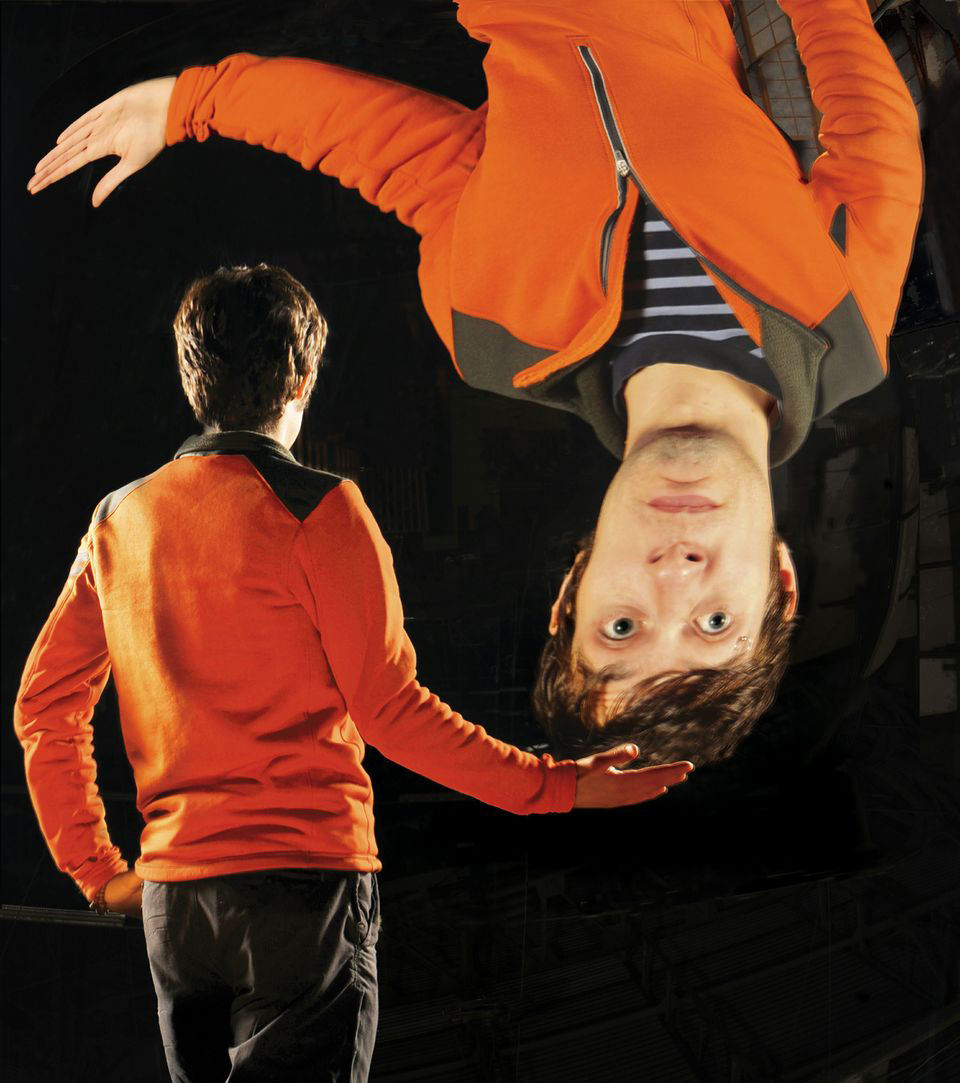
And my very first week there, just a day or two after I got there, I discovered all the city's museums would be free on Thursday. So you know what I did: I walked from the Green Tortoise Youth Hostel, all the way across the Marina district, to the Exploratorium.
I got there and they said the Tactile Dome was open that day, and required a reservation and an entrance fee, even though the rest of the Exploratorium was honoring SF's Free Museum day. It was a bit expensive, and I was on a vagabond's budget and had expected the day to be completely free (and had quite honestly enjoyed the idea that after waiting 20 years to see it they'd opened it to me for free.) But, I'd waited 2/3 of my life to be at the Exploratorium, there was no way I was going to let a few bucks stand between me and the full experience, which had to include whatever the Tactile Dome was.
I spent the afternoon wandering around the Exploratorium and having the time of my life. Many of the exhibits I'd read about 20 years earlier were still there: the room where a strobe flash could capture your shadow on the phosporescent walls, tubes that conducted and generated sound, the magnetic device still with the sign warning you to keep your BART cards away.
One particularly strong flashbulb memory was discovering they had a large section of the 1987 AIDS memorial quilt on display in a section of the museum. That was, as I described it at the time, an unexpected hard right turn into reality. The panels, made by real people, about their love for other real people who had been taken away too young by a ravaging disease, hit me hard. I admit that I teared up looking at it.
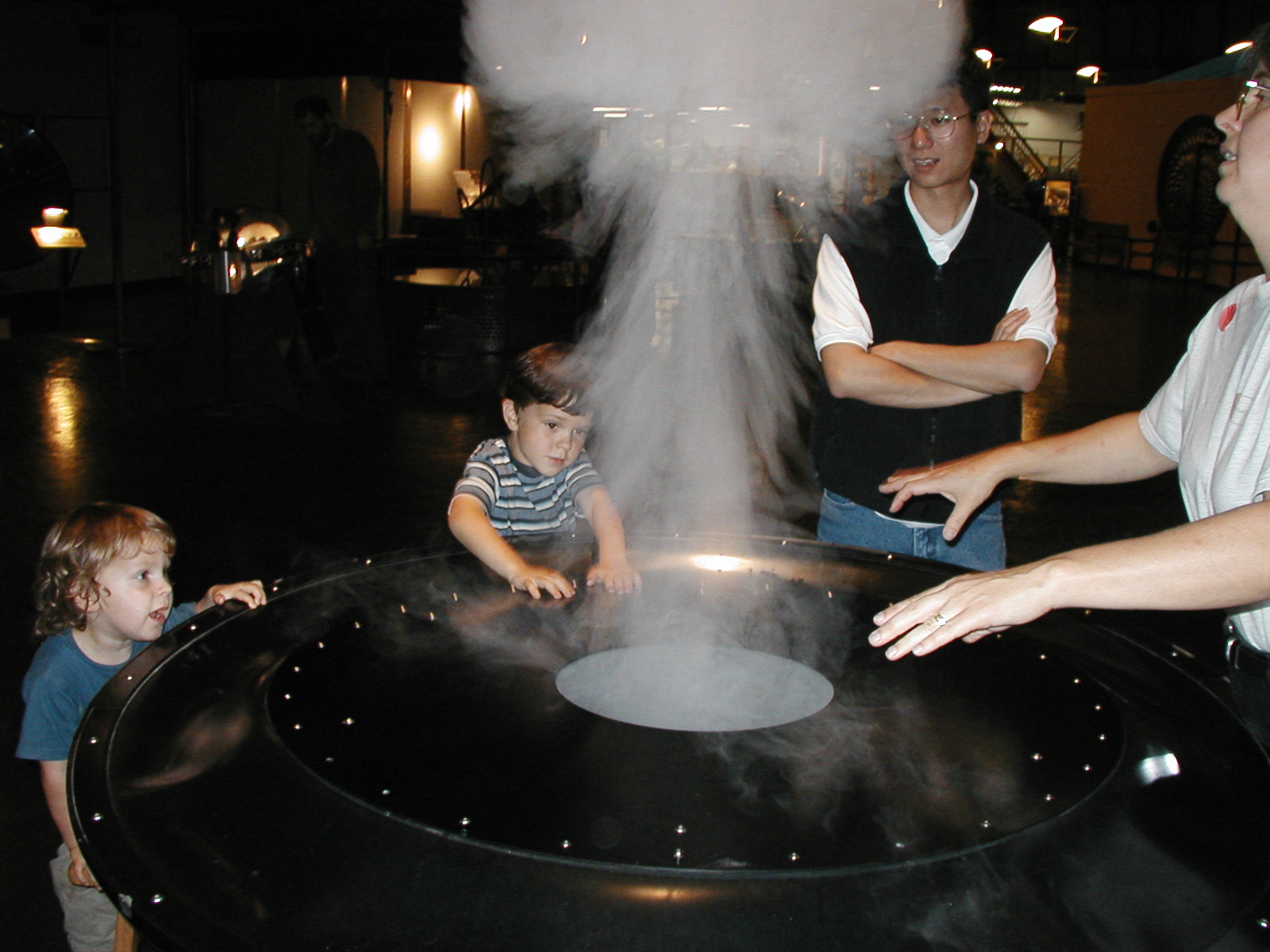
Visitors collaborate to make a smoke ring at the Exploratorium's previous location at the Palace of Fine Arts. By D'Arcy Norman of Calgary, Canada, CC BY 2.0, Link
Finally, my appointment time rolled around, and I made my way to the back of the museum to enter the Tactile Dome. I had no idea what it was, other than, as I could see from outside, it was a large dome.
The Tactile Dome turned out to be wonderful. The dome contained a series of unlit rooms and passages, which you found your way through by sense of touch. One room's wall was covered with furry shapes, one passage dumped you into a room that was filled to a depth of a foot or two with beans. The reason they required an appointment is that they spaced out the entries so nobody bumped into anyone else making their way through it, you felt like you had it to yourself the whole way.
There was just one room in the Tactile Dome that had one dim light in it. I recall it to be a circular room, ringed by a ledge or a bench, with one colored bulb stashed somewhere to privide a minimum of light. Under one part of the ledge was a small opening that seemed to lead directly into a spinning fan. And that was it. I couldn't find any other way out.
I felt around the ledge and the room for several minutes of mounting irrational panic. I just couldn't find any way out but the apparent ventilation shaft, but that fan sounded awfully close. It wasn't until I had been in there, slowly getting more and more scared, long enough that the next people to be admitted after me caught up, emerging into the room through the same passage I had, that I regained my sense. Suddenly, in the presence of other people, rationality took over: the "ventilation shaft" was the only other opening, and of course that was the way out. I'd let the darkness and the strange sensations overwhelm me, and with other people present, I suddenly felt silly. I crawled into the "ventilation shaft", and of course, the fan wasn't right there blocking it, it was indeed just a passage to the next chamber. But it was a bizarre few minutes.
And the room full of beans was very fun.
It's still a dynamite museum. I'm pleased to report that I recently had cousins in town, the kids are I think about 12 and 15, and they spent a whole day at the Exploratorium, and loved every minute of it. Almost fifty years after I first read about this wonderful place in a city so far-off it may as well have been imaginary, it's still wonderful.
5. How A Chance Scientific Injustice Launched My Career As An Author Of Doggerel(The Boston Science Museum, Boston, 1993)
In 1993, shortly before leaving on the big road trip that changed my life, I took a shorter "practice" road trip up through New England, and stopped in Boston for a while to visit my old friend and former bandmate Christopher Hume, then a composer who'd recently opened his own music publishing company. Among our many adventures that week was a trip to the large Boston Science Museum... I don't have much of a story to go with this, except that they had a huge entomology exhibit, which I wandered in growing disappointment that for all they covered in the huge exhibit, my favorite species since childhood, the pillbug, didn't get its own display...
...until I discovered, do my dismay, a pillbug did turn up... curled up in a bowl of chow placed in a huge beetle's cage. This led to one of my first and still favorite pieces of doggerel that I ever wrote. For more details about this profound and life-changing experience, see that piece.
I also recall with some amusement, that the section of the exhibit dedicated to beetles was called "Meet the Beetles", with the subtitle, "They're the biggest group in the world". A little entomological humor, there.
And the very next section, on species that predate on beetles, was labeled "Eat the Beetles".
Ok, maybe the pillbug didn't get its due, but at least someone at that museum did have a sense of humor. Maybe I should have sent them my poem.
6. Honorable mention: Long Wires in Dark Museums by Alastair Galbraith and Matt De Gennaro (Table of Elements records, 2002)
This isn't a museum. It's an experimental music album by New Zealand avant-folk artist Alastair Galbraith. But it was recorded in a museum, and I can't end without mentioning it. Galbraith and collaborator De Gennaro strung piano wires across museum galleries, turned down the lights, and played them with bows.
That's it. It's exactly what the title sounds like... 45 minutes of bowed wires played in the dark in a museum: Long Wires in Dark Museums.
Bonus Gallery: Museum Memories Extra Images
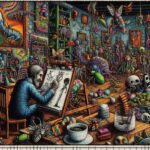
Here are some additional images I created while working on the featured image for March 2026 Indieweb Carnival piece "Museum Memories".
AI image copyright info
Under current US copyright law, unaltered AI-generated images are not copyrightable. However, all AI-generated content on this site has been subjected to a subsequent creative process of manual human edits and alterations, bringing them back into the realm of human authorship. All original content on this site, including AI-assisted images, is ©2024 Michael Kupietz.


Article syndication: #indienews Fediverse


_cover.jpg)
Comments are closed
Reposts